

The Exact Algebraic Reverse-Fee Formula: Eliminating Invoice Undercharging
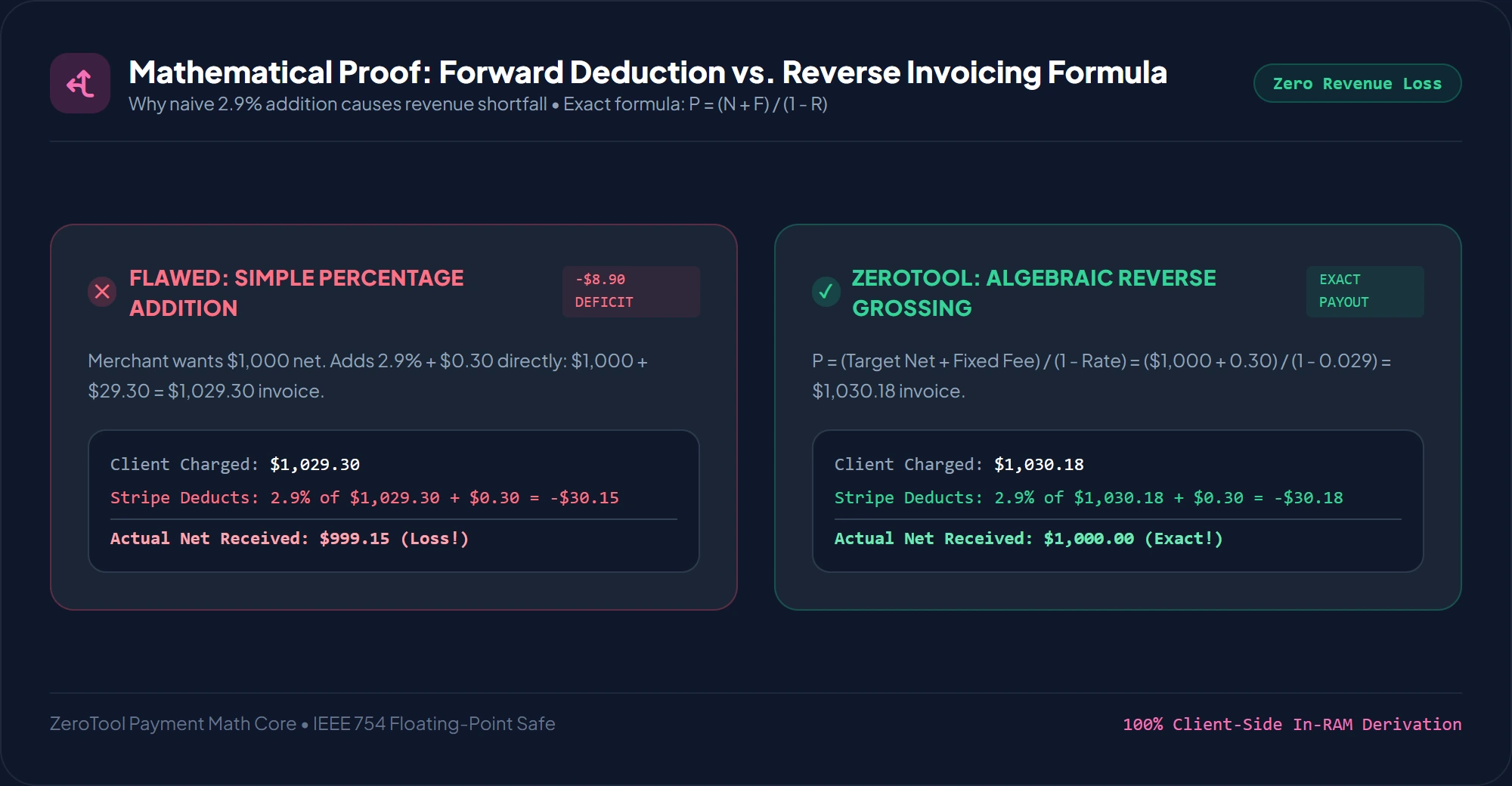
The single most common financial mistake made by freelancers, agencies, and SaaS billing managers is the naive percentage addition fallacy. When a service provider wants to net exactly $1,000 from an invoice, they frequently multiply $1,000 by 2.9% ($29.00), add the $0.30 fixed fee, and bill the client $1,029.30. However, when Stripe processes that $1,029.30 transaction, it assesses the 2.9% fee against the new higher gross amount, taking $29.85 plus $0.30 ($30.15 total), leaving the merchant with $999.15. Across thousands of transactions or high-value enterprise invoices, these fractional discrepancies accumulate into thousands of dollars in unrecovered operating losses.
To achieve zero revenue loss and guarantee an exact net payout, merchants must apply the formal reverse grossing algebraic equation. Let P represent the Gross Invoice Price charged to the client, N represent the Target Net Payout required in your bank, R represent the variable processing rate in decimal format (e.g., 0.029 for 2.9%), and F represent the fixed assessment fee (e.g., 0.30):
The ZeroTool Client-Side Financial Pipeline
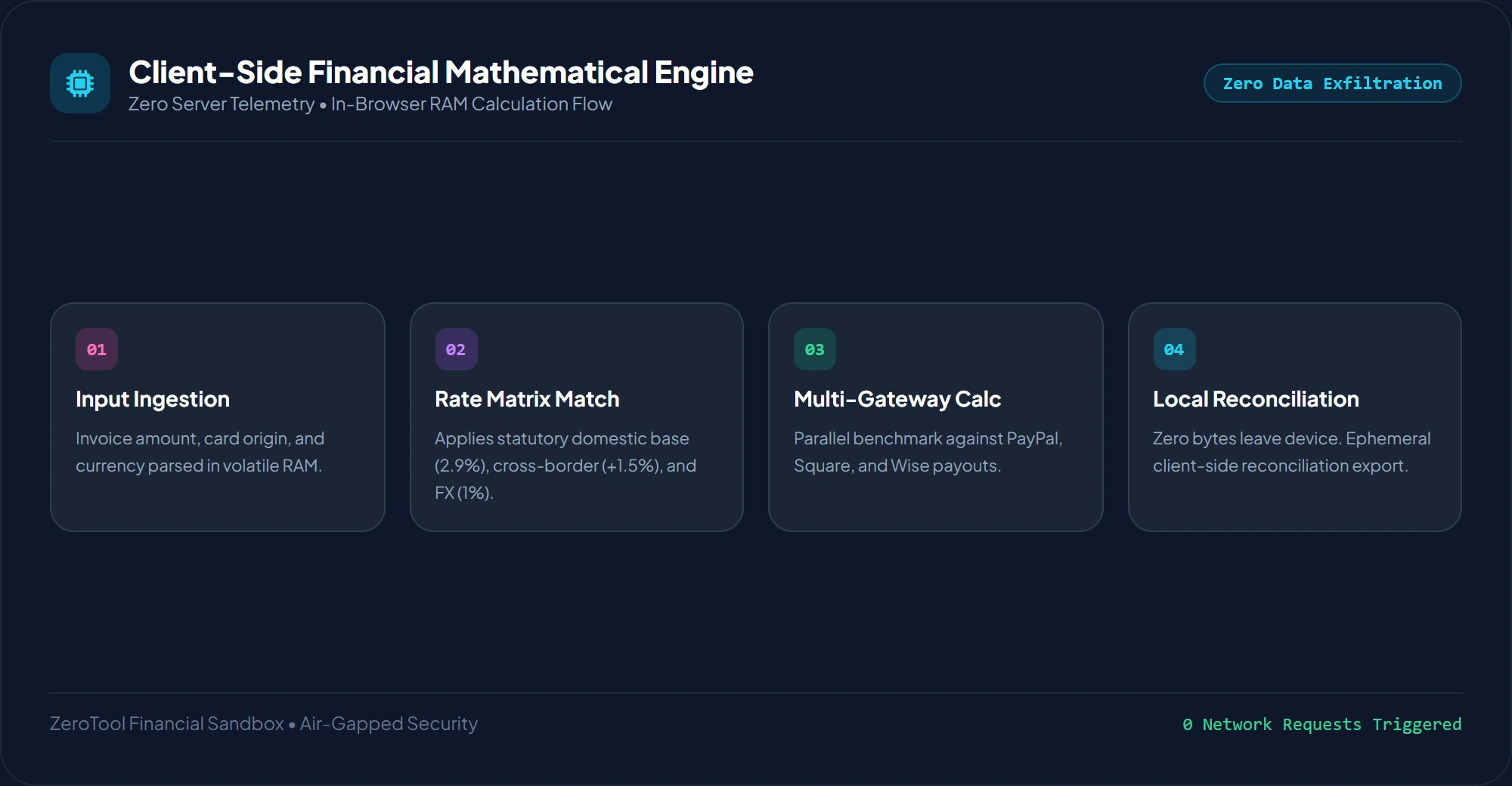
In contrast to centralized portals that log your transaction values and client billing volumes into commercial marketing databases, ZeroTool executes 100% of the mathematical derivation inside your browser's private memory sandbox. When you calculate fees:
User values entered into numerical inputs are parsed directly into local JavaScript execution memory using integer-cent representations to eliminate IEEE 754 floating-point rounding errors.
The client-side engine matches regional rate tables across US, UK, EU, and Asia-Pacific structures, combining domestic bases with cross-border (+1.5%) and FX conversion multipliers (1%–2%).
In a single thread cycle, the engine benchmarks net take-home earnings simultaneously across Stripe, PayPal Commerce, Square, and Wise, outputting itemized comparative spreads.
Zero bytes are transmitted over external networks. All financial calculations, fee breakdowns, and reverse invoice statements reside strictly in browser RAM and are purged instantly when the tab is closed.
Regional Stripe Fee Structure Matrix: 2026 Sovereign Rate Schedules
Payment processing fees are not universal; they are deeply influenced by regional financial regulations, interchange fee caps, and sovereign currency volatility. When using a calculate stripe fees tool, selecting your specific account country is crucial for accurate financial modeling:
1 United States (USD Account Base)
Standard US domestic transactions carry a base rate of 2.9% + $0.30. International cards add +1.5%, while foreign currency conversion adds +1.0%. ACH Direct Debit offers significant fee savings at 0.8% with an absolute ceiling of $5.00 per transfer.
2 United Kingdom (GBP Account Base)
Reflecting lower European interchange fee caps, standard UK consumer cards are processed at 1.5% + 20p. Non-UK cards incur an additional +1.5% cross-border fee (2.5% for EEA cards post-Brexit). Bacs Direct Debit transactions are charged at 1.0% + 20p capped at £2.00.
3 European Union (SEPA & Eurozone)
Under EU Regulation 2015/751 capping consumer interchange at 0.2% for debit and 0.3% for credit, standard Eurozone domestic cards are billed at 1.5% + €0.25. SEPA Direct Debit transfers provide exceptional merchant efficiency at 0.35% + €0.35 per transaction.
| Merchant Jurisdiction | Standard Domestic Rate | International Surcharge | Local Low-Cost Rail |
|---|---|---|---|
| United States (USD) | 2.9% + $0.30 | +1.5% (+1.0% FX) | ACH Direct Debit (0.8%, $5 cap) |
| United Kingdom (GBP) | 1.5% + £0.20 | +1.5% (+2.0% FX) | Bacs Direct Debit (1.0%, £2 cap) |
| Eurozone / EU (EUR) | 1.5% + €0.25 | +1.5% (+2.0% FX) | SEPA Direct Debit (0.35% + €0.35) |
| Australia (AUD) | 1.75% + A$0.30 | +1.5% (+2.0% FX) | BECS Direct Debit (1.0%, A$3.50 cap) |
| Canada (CAD) | 2.9% + C$0.30 | +1.5% (+2.0% FX) | Pre-Authorized Debit (PAD) (0.8%) |
Step-by-Step Visual Guide: Calculating Exact Net Payouts & Reverse Invoicing in Seconds
Follow this financial engineering procedure using ZeroTool's stripe payout calculator to model domestic processing fees, calculate international surcharges, and compute exact client invoicing gross amounts:
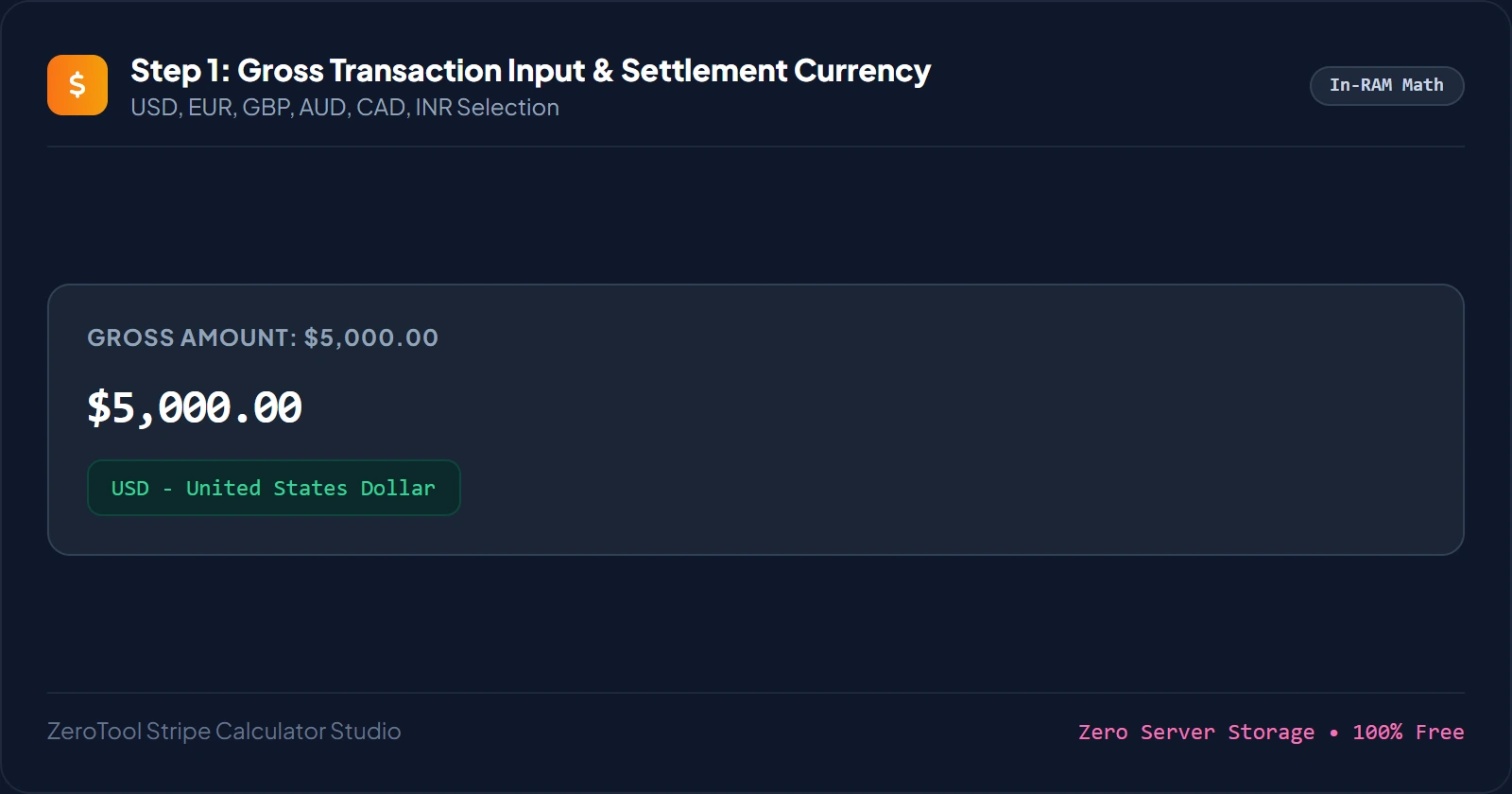
Gross Transaction Input & Settlement Currency Selection
Enter your total invoice value into the numerical input field and choose your primary bank deposit currency (USD, EUR, GBP, AUD, CAD, INR). The internal calculator initializes high-precision decimal registers to prevent floating-point rounding divergence.
Card Origin & Regional Processing Tier Toggling
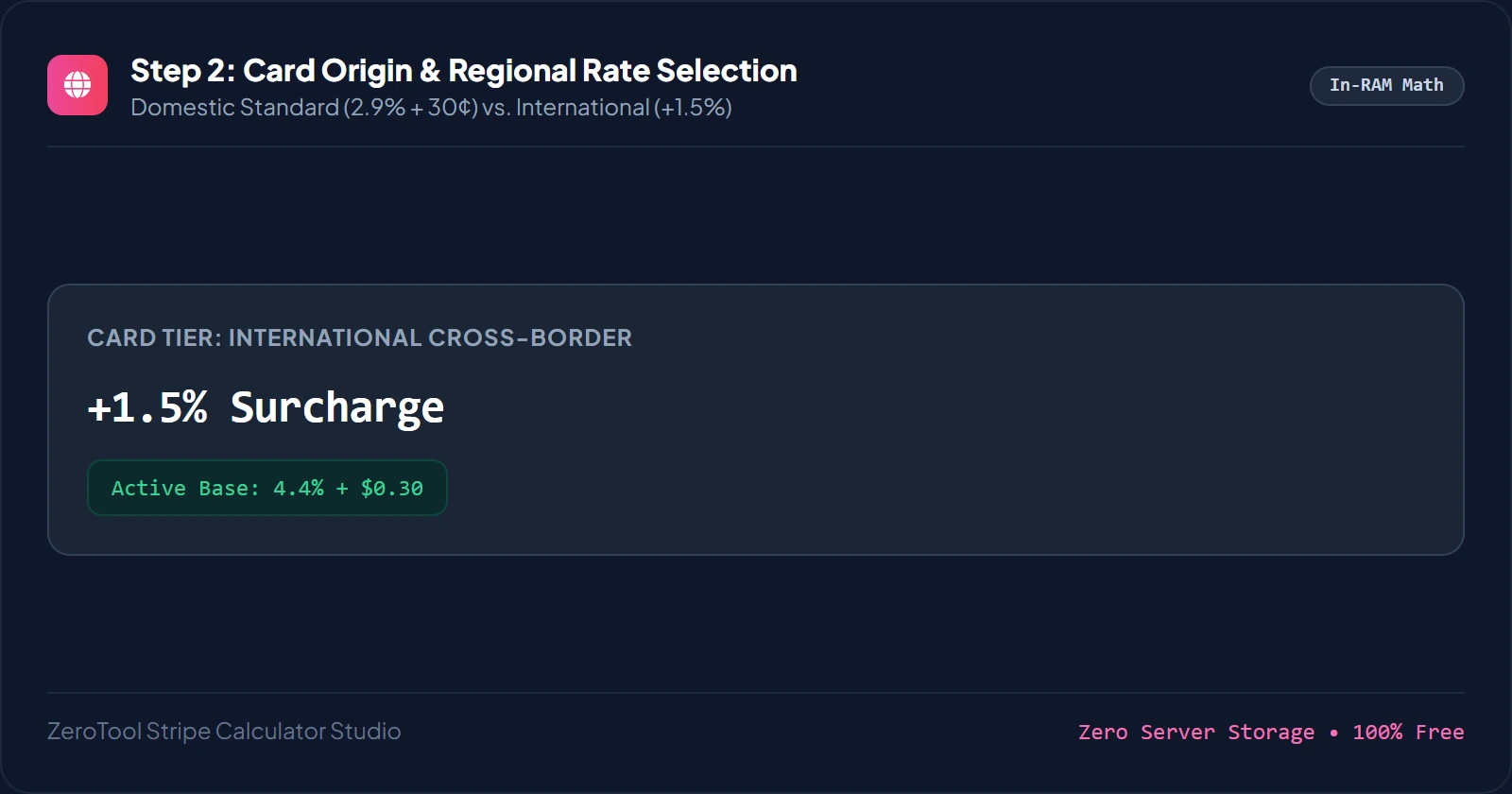
Toggle between domestic payment cards and international cross-border cards. Selecting international instantly applies the statutory +1.5% assessment markup and adjusts fixed per-transaction fee structures to match card network rules.
Currency Conversion FX Spread Configuration
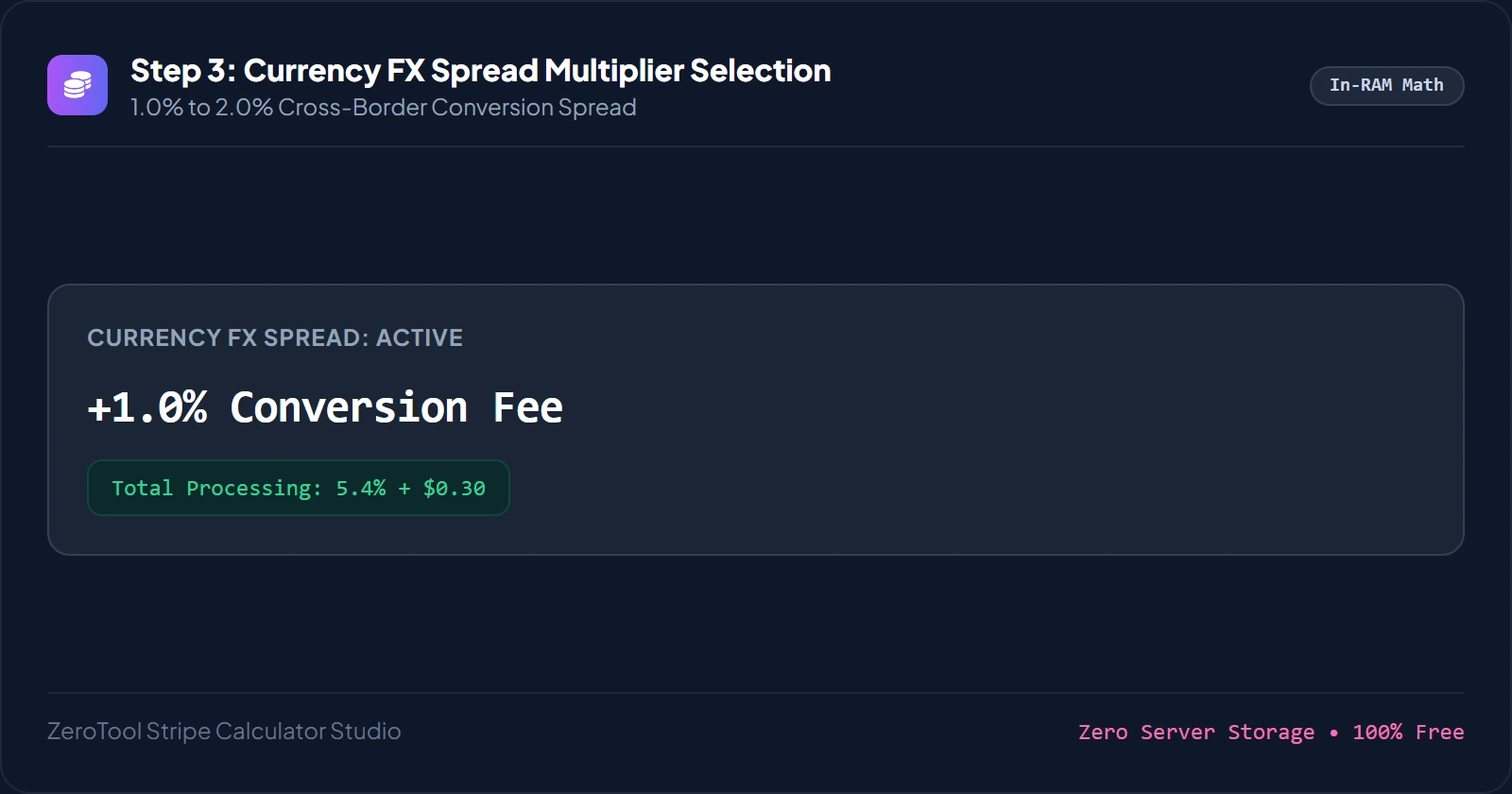
For foreign customer billing where invoice currency differs from merchant settlement currency, activate the currency conversion toggle. Choose the applicable 1.0% or 2.0% FX spread to simulate exact bank deposit figures after interbank markup.
Reverse Invoicing Mode Activation (Target Net Payout)
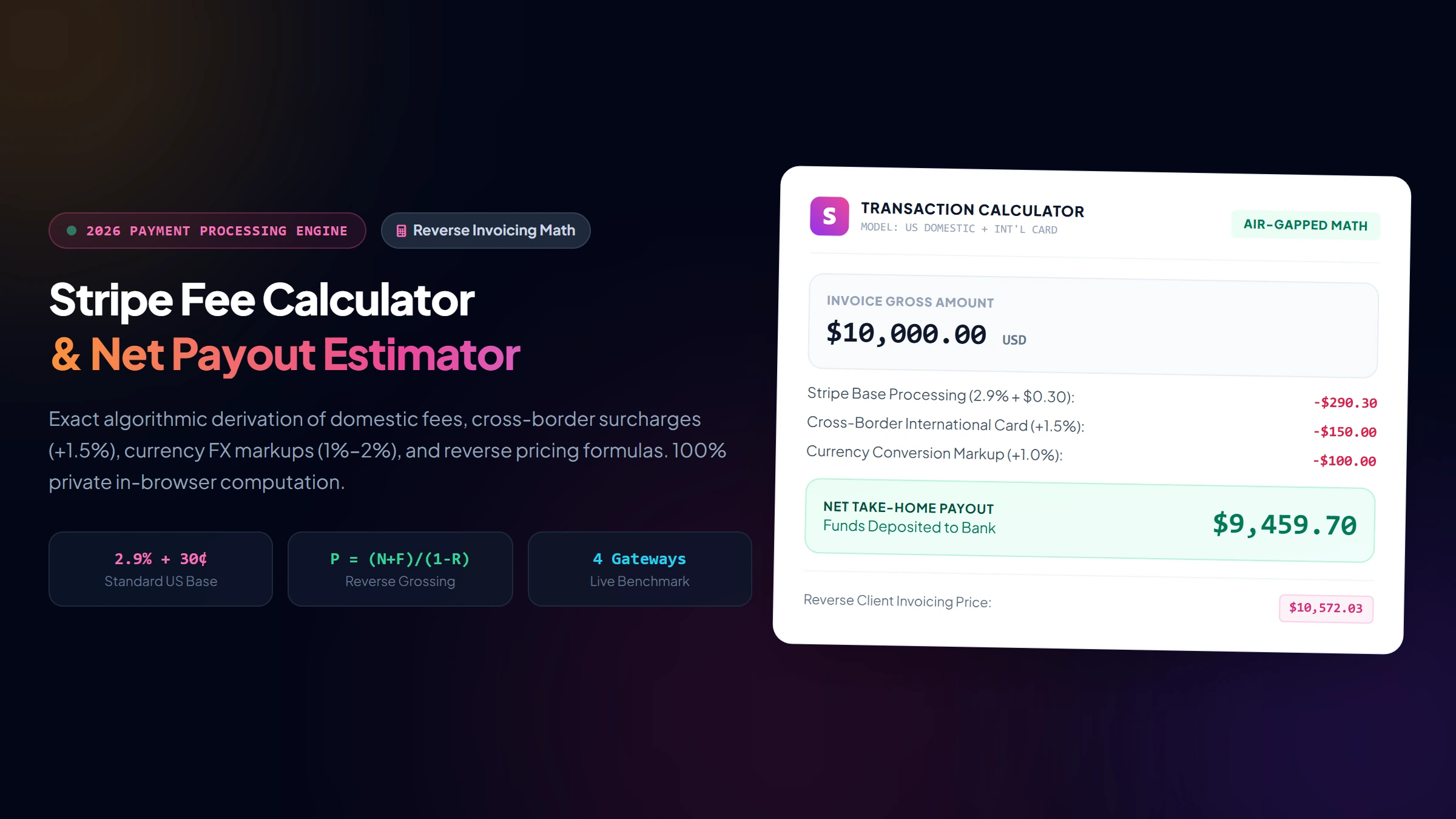
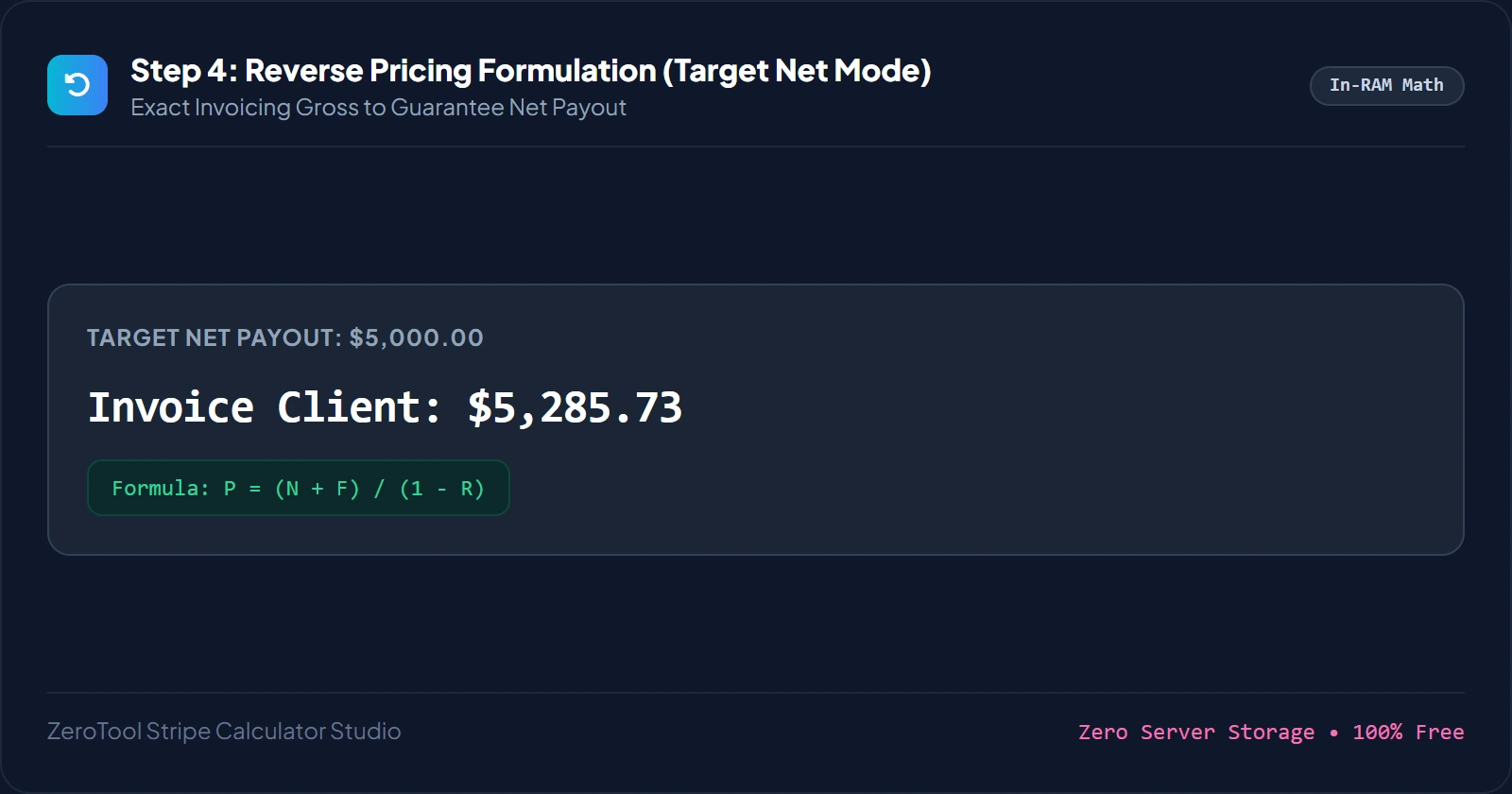
Switch calculation direction from "Forward Fee Deduction" to "Reverse Invoicing Mode". Enter the exact net payout required in your bank account; the engine executes P = (N + F) / (1 - R) to display the exact gross figure to put on your client invoice.
Multi-Gateway Comparative Benchmark Audit
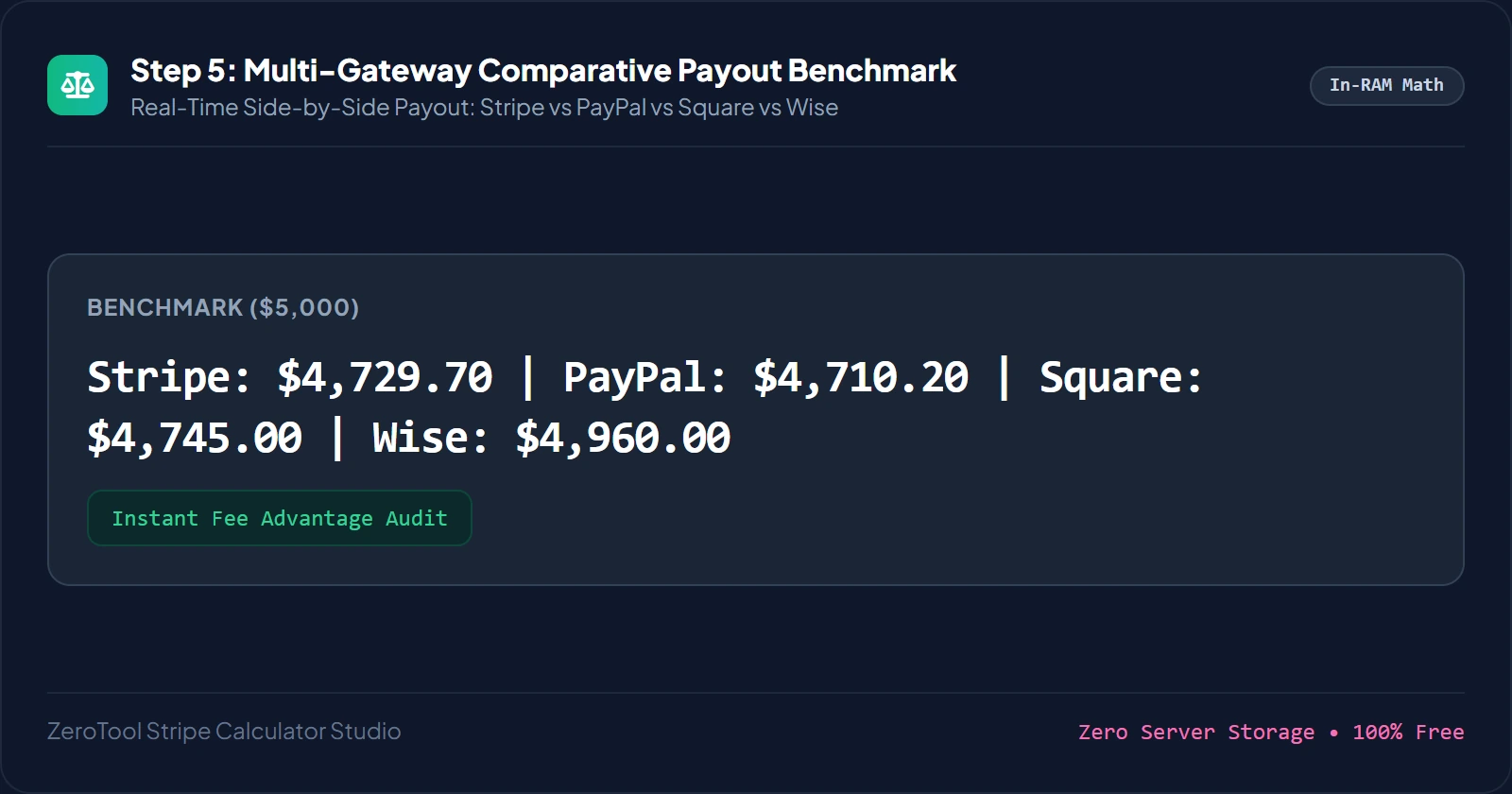
Review the real-time parallel benchmark table. Compare your net take-home earnings on Stripe against PayPal Commerce (3.49% + $0.49), Square Online (2.9% + $0.30), and Wise Business Payouts to select the most cost-effective gateway for each transaction size.
Itemized Fee Reconciliation & Audit Report Export
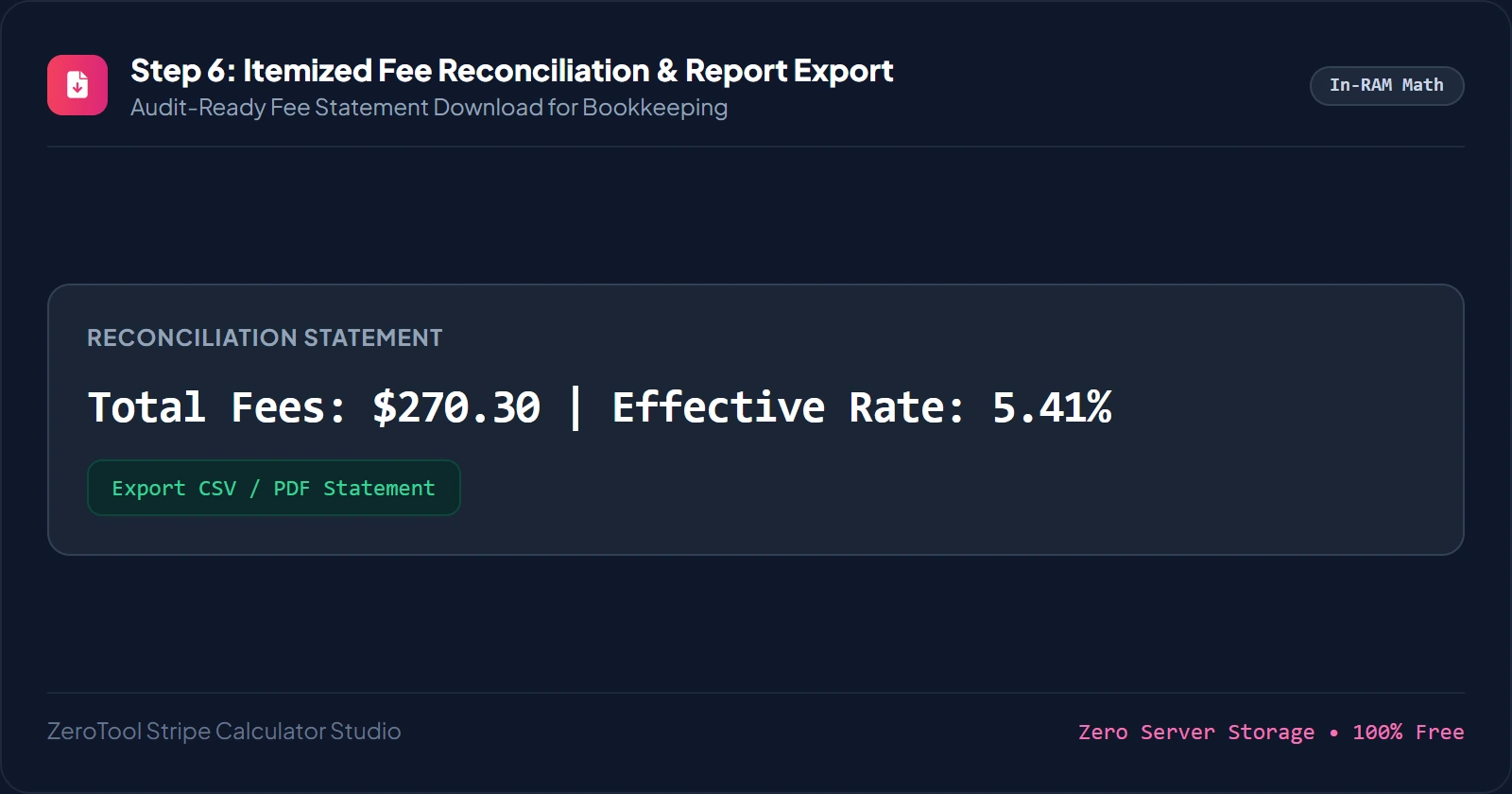
Click "Export Reconciliation Statement". The browser synthesizes an itemized breakdown of base processing, international surcharges, and FX fees into a clean document, ready for integration into your accounting ledger and tax deduction archives.
The 6-Point Enterprise Payment Fee Optimization Checklist
Prior to processing large volume contracts or scaling payment flows, enterprise merchants should execute these 6 financial optimizations to systematically compress payment processing overhead:
ACH & Direct Bank Rail Routing
For B2B invoices exceeding $2,000, incentivize clients to pay via ACH Direct Debit (capped at $5.00 total) instead of credit cards, saving over $285 per $10,000 transaction.
Level 2 & Level 3 Data Enrichment
Pass customer tax IDs, line item descriptions, and postal codes with credit card payloads. Visa and Mastercard grant interchange discounts of 0.50% to 1.00% on enriched corporate B2B card transactions.
Multi-Currency Bank Settlement Accounts
Attach dedicated EUR, GBP, and CAD receiving bank accounts to your Stripe dashboard. Settling foreign sales into matching local currency accounts eliminates Stripe's 1% to 2% FX conversion markup.
Stripe Radar 3D Secure Threshold Tuning
Configure Radar fraud rules to trigger 3D Secure (3DS) authentication on high-risk orders. 3DS shifts fraudulent chargeback financial liability from the merchant to the card-issuing bank.
Annual Volume Threshold Negotiation
Once annual payment volume crosses $1,000,000, request custom enterprise pricing from Stripe sales. Typical negotiated rates reduce variable fees to 2.2%–2.5% with lowered fixed transaction costs.
Reverse Contract Clause Standardization
Incorporate explicit credit card processing surcharge clauses in service agreements: "Credit card remittances incur processing surcharge computed per ZeroTool mathematical reverse grossing formula."
Architectural Comparison: Stripe vs. PayPal vs. Square vs. Wise
Evaluating payment processing costs across competing global platforms requires analyzing fixed transaction costs, cross-border surcharges, and payout speed:
| Platform / Gateway | US Domestic Online | International Surcharge | Currency FX Spread | Standard Bank Payout |
|---|---|---|---|---|
| Stripe | 2.9% + $0.30 | +1.5% | 1.0% (US) / 2.0% | 2-Day Rolling (Free) |
| PayPal Commerce | 3.49% + $0.49 | +1.5% | 3.0% to 4.0% | 1-3 Days (Free) |
| Square Online | 2.9% + $0.30 | +0.0% (Included) | Not Supported | Next Business Day |
| Wise Business | 0.43% Average | Mid-Market Rate | 0.3% to 0.7% | Instant / Same Day |
Frequently Asked Questions: Stripe Fees, Payouts & Surcharging
Are Stripe payment processing fees tax deductible as business expenses?
Yes. Under IRS guidelines and most global tax frameworks, payment processing fees deducted by Stripe constitute ordinary and necessary business operating expenses (Schedule C Line 10 or Form 1120). You should report the full gross sales revenue and deduct Stripe fees separately to maintain accurate gross margin and tax accounting records.
Is it legally permissible to pass Stripe processing fees directly to clients?
Credit card surcharging is legally permitted in the majority of US states and international jurisdictions, provided proper disclosure is made prior to checkout and surcharges do not exceed actual merchant processing costs. However, surcharging debit cards is strictly prohibited under US federal law (Durbin Amendment). In the UK and EU, Consumer Rights Directives prohibit card surcharging for consumer retail, though B2B surcharging remains widely permissible.
Does Stripe return transaction processing fees when issuing a customer refund?
No. Since 2020, Stripe's global policy states that original processing fees are not returned when a charge is refunded (partially or fully). The merchant must absorb the original fee out of pocket while the customer receives 100% of their payment back.
What is the difference between standard rolling payouts and instant payouts?
Standard Stripe payouts operate on a 2-day rolling schedule (funds settle into your bank account two business days after charge capture) at zero additional charge. Instant Payouts allow eligible merchants to transfer funds to an active debit card within 30 minutes for an additional 1.0% fee (minimum $0.50).
Eliminate Payment Margin Loss With ZeroTool
Calculate exact take-home payouts & reverse invoicing gross in real-time. 100% free & private.